Hitachi and FANUC enter strategic partnership toward joint commercialization of physical AI implementation
Combining Hitachi's AI with FANUC's robots to practice and deploy physical AI at Hitachi's manufacturing sites
September 30, 2026
FANUC CORPORATION
- By combining Hitachi's AI, which enables rapid learning, with FANUC's industrial robots equipped with AI technologies, the companies will build advanced Physical AI that can be applied immediately to complex tasks
- Through joint validation using Hitachi Group factories as "Customer Zero," the companies will further train and evolve Physical AI and, beginning in fiscal 2027, jointly deploy it by leveraging their global customer bases
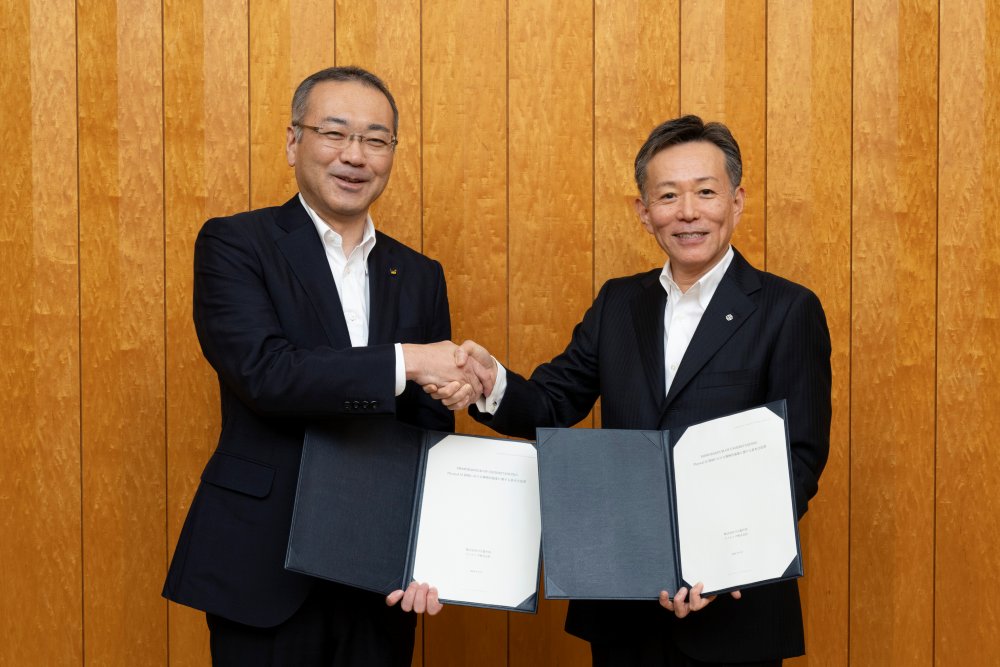
From left: Kenji Yamaguchi, President and CEO, FANUC;
Toshiaki Tokunaga, President and CEO, Hitachi
Tokyo, Japan, September 30, 2026 - Hitachi, Ltd. (TSE: 6501, "Hitachi") and FANUC CORPORATION (TSE: 6954, "FANUC") today announced that they have entered into a strategic partnership toward the joint commercialization of Physical AI implementation. Under this partnership, the two companies will promote the joint validation and joint deployment of Physical AI that combines Hitachi's AI technologies, represented by HMAX Industry, with FANUC's industrial robots equipped with AI technologies. In the validation, Hitachi Group factories will be used as "Customer Zero," where AI will continuously learn site-specific rules in production activities. This will enable the practical application of Physical AI that can respond flexibly and accurately to issues arising at actual manufacturing sites, beyond what can be achieved solely through imitation learning or simulations in virtual environments (digital twins).
By leveraging the Physical AI implementation and operational know-how gained through the joint validation, the two companies will begin deploying solutions to customers in fiscal 2027, utilizing their global installed bases across a wide range of industries, including semiconductors, pharmaceuticals, healthcare, advanced materials, automotive, logistics, food, shipbuilding, and agriculture. By significantly accelerating the autonomy of tasks that rely on skilled-worker experience and manual labor, including parts supply and changeovers when production models are switched, the companies will help customers address challenges such as labor shortages and skills transfer.
Overview of the Joint Validation
As an initial step, Hitachi will utilize its manufacturing facilities in the Ibaraki region as "Customer Zero" and work toward establishing the Physical AI technologies required for deployment in real-world production environments by fiscal 2027. The collaboration will focus on applications such as picking parts of various shapes and performing changeovers when production items change. By combining Hitachi's Physical AI models with FANUC's robotics and AI technologies, the companies will evaluate and improve recognition accuracy, robot motion, takt time*1, and quality effectiveness. The partners will also validate the effectiveness of combining Hitachi's edge AI semiconductor*2 with FANUC's industrial robots.
By enabling AI to continuously learn from a wide variety of data, the companies will build mechanisms for the flexible operation of individual processes, production lines, and entire factories, with the aim of realizing sustainable manufacturing environments where people and robots collaborate while leveraging their respective strengths.
*1 Takt Time: The standard amount of time allocated to produce or process one product or complete one task.
*2 Hitachi’s News Release “Hitachi develops edge AI semiconductor as a core technology for physical AI to support HMAX Industry”
Comment from Toshiaki Tokunaga, President and CEO, Hitachi, Ltd.
Hitachi has been working to transform social infrastructure by combining AI with the domain knowledge it has accumulated at social infrastructure sites. Through this strategic partnership with FANUC, we aim to innovate manufacturing sites that support people's lives and industries through the use of Physical AI. By combining FANUC's world-class advanced industrial robotics technologies with Hitachi's manufacturing expertise, production-line engineering capabilities, and digital technologies, we will accelerate the implementation of Physical AI at manufacturing sites. By applying the outcomes gained through our Customer Zero initiatives and providing customers with integrated support from on-site Physical AI implementation through operation and continuous improvement, we will contribute to improving productivity and quality across manufacturing operations and addressing social challenges such as labor shortages.
Comment from Kenji Yamaguchi, President and CEO, FANUC CORPORATION
Recent advances in AI technologies have expanded their use not only among businesses but also among consumers. Today, the practical deployment of Physical AI, where AI perceives, reasons about, and acts in the physical world through robots and machines, is becoming a reality across various industries. This strategic partnership will accelerate the deployment of Physical AI by combining Hitachi's advanced AI technologies with FANUC's highly reliable products, sophisticated control technologies, AI expertise, and extensive robotics experience.
By positioning Hitachi's manufacturing facilities as 'Customer Zero,' we will increase the development and deployment of practical Physical AI solutions that can operate reliably in real production environments. We believe this will provide a pathway toward autonomizing many production processes that manufacturers around the world face today.
Together with Hitachi, we will further expand the scope of Physical AI applications and contribute to solving pressing societal challenges, including labor shortages and the transfer of skills and expertise from experienced workers to future generations.
Background of the Strategic Partnership
As labor shortages continue to intensify worldwide, manufacturers have increasingly adopted automation systems that repeatedly perform predefined tasks under fixed conditions. However, many operations, including parts handling, machine loading, machining and assembly, product changeovers, and material transfer between processes, still require human judgment and adaptability in response to changing conditions and varying workpieces. Tasks such as picking and production line setup changes remain heavily dependent on human workers. As a result, achieving true autonomy, where machines can perceive changing situations, make decisions, and control their own actions, has become one of the most significant challenges facing the manufacturing industry today. Physical AI technologies that leverage Japan's manufacturing strengths, including shop-floor knowledge and process-improvement capabilities essential to collecting and utilizing real-world data, are expected to provide a solution.
Hitachi has cultivated operational technology (OT) and control expertise across sites in 190 countries and regions through more than 110 years of manufacturing experience. By combining high-quality products with advanced digital technologies, Hitachi promotes Social Innovation Business worldwide. As a manufacturer itself, Hitachi leverages data generated from both its own and customers' digitized manufacturing assets to advance the deployment of Physical AI enhanced by deep domain knowledge.
FANUC is accelerating the deployment of Physical AI by advancing AI-enabled industrial robotics and supporting open platforms that allow developers worldwide to implement sophisticated robotic control using familiar development environments. Through these initiatives, FANUC is enabling robots to perceive, evaluate, and act autonomously with high precision in real time.
By combining these complementary strengths, Hitachi and FANUC will establish Physical AI that can adapt to changing production environments, continuously perceive, learn, and optimize operations on the shop floor, and accelerate deployment across global industries through joint validation and commercialization efforts.
About Hitachi, Ltd.
Through its Social Innovation Business (SIB), which leverages IT, OT (Operational Technology), and products, Hitachi aims to become a global leader in continuously transforming social infrastructure through digital technologies and to contribute to a harmonized society where the environment, wellbeing, and economic growth are in balance. Hitachi operates globally through four sectors - Digital Systems & Services, Energy, Mobility, and Connective Industries - as well as the Strategic SIB Business Unit, which creates new growth businesses. With Lumada at its core, Hitachi generates value from data to solve customer and social challenges. Revenues for fiscal 2025 (ended March 31, 2026) totaled JPY 10,586.7 billion. As of March 31, 2026, Hitachi had 606 consolidated subsidiaries and approximately 290,000 employees worldwide. For more information, visit www.hitachi.com/
About FANUC CORPORATION
Since successfully developing Japan's first domestically produced numerical control (NC) system and servo mechanism for machine tools in 1956, FANUC has consistently pursued automation across manufacturing and other industries. FANUC operates its FA (Factory Automation) business based on these core technologies, as well as its ROBOT and ROBOMACHINE businesses that apply these technologies to a wide range of industrial applications. For the fiscal year ended March 31, 2026, FANUC reported consolidated net sales of JPY 857.8 billion and employed 10,040 people on a consolidated basis.