FANUC Open Platform

The Future of Smart Agriculture Through Human-Robot Collaboration
Automation using FANUC robots and AI is beginning to take shape in grape-growing operations facing labor shortages and an aging workforce. A research team at the University of Yamanashi is working to reduce the labor required for berry thinning through physical AI built on FANUC open platform. We spoke with the team about their research, which is opening up the future of smart agriculture through repeated field trials under demanding agricultural conditions. This research is being conducted as part of the Commissioned Research Project for Smart Agricultural Technology Development and Deployment administered by the Bio-oriented technology Research Advancement InstitutioN (BRAIN).
Challenges Facing Grape Growers
Worsening Labor Shortages and an Aging Workforce
Yamanashi Prefecture is renowned as one of Japan's leading grape-producing regions. In recent years, however, the agricultural sector has faced increasingly severe labor shortages and an aging workforce. According to statistics released by Yamanashi Prefecture, the number of core agricultural workers in the prefecture fell by approximately 17% over a five-year period. More than 70% are aged 65 or older, and approximately 60% are aged 70 or older. These trends also pose a major challenge for grape cultivation. Growing premium grapes, particularly varieties such as Shine Muscat, requires a high level of skill and experience.
Berry Thinning Requires Expert Skill
Among the various cultivation tasks, berry thinning is particularly important because it directly affects the final market value of the grapes. To achieve the desired cluster shape and berry size, workers must assess each berry individually and remove those that are unnecessary. The task not only requires advanced skill and intense concentration, but also directly impacts quality. Berry thinning must also be completed within a short period. In some cases, growers must process 3,000 clusters in approximately ten days during June. Despite the heavy workload, the task is difficult to entrust to seasonal workers, making it an even greater challenge as labor shortages become more severe.
Solving These Challenges with AI and Robots
To address these issues, the University of Yamanashi research team is developing an automated berry-thinning system using AI and robots. By incorporating human experience and expertise into AI, the team aims to establish a new agricultural framework in which people and robots work together.
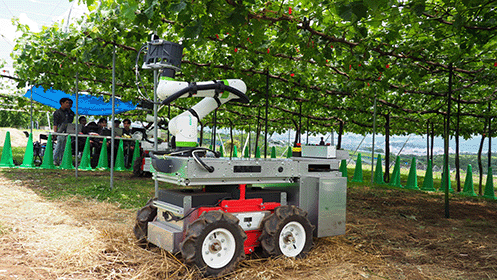
Automating Berry Thinning with Physical AI
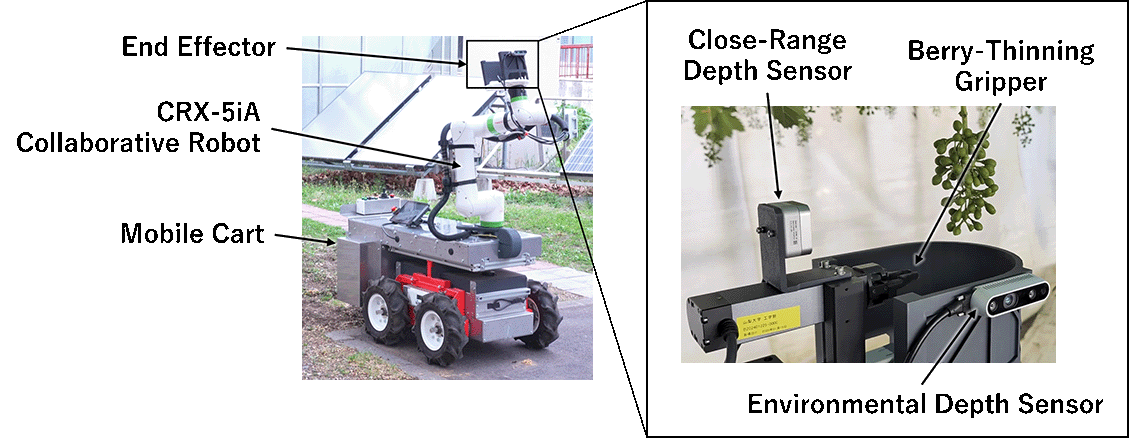
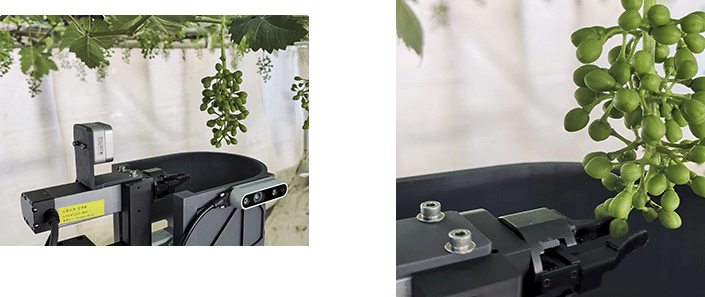
The University of Yamanashi research team has developed a physical AI system centered on FANUC's CRX-5iA collaborative robot and equipped with two types of depth sensors and a berry-thinning gripper. By coordinating these components, the system automatically performs the entire process, from detecting grape clusters to thinning berries.
Key Components
-
• CRX-5iA Collaborative Robot
The robot's end effector is equipped with two types of depth sensors and a berry-thinning gripper. The robot moves the end effector to the position determined by the AI. -
• Environmental Depth Sensor
This sensor captures point-cloud data of the grape trellis and surrounding environment. The data is used to detect target clusters and plan the robot's path. -
• Close-Range Depth Sensor
This sensor measures the cluster in detail at close range and obtains the information required to create a 3D model and identify berries for thinning. -
• Berry-Thinning Gripper
A sliding gripper grasps and removes berries that the AI has identified as unnecessary. -
• Mobile Cart
The cart travels through the vineyard and transports the robot to each target cluster.
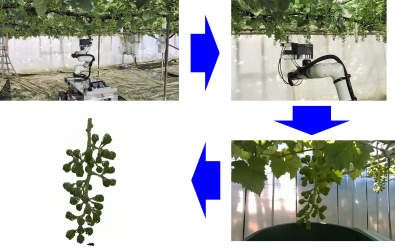
See, Think, Act: How Physical AI Performs Berry Thinning
The process begins with the environmental depth sensor capturing point-cloud data of the grape trellis and the surrounding area. Using this data, the AI detects the target cluster and plans a path that allows the CRX-5iA to approach it while avoiding nearby branches and obstacles. Once the CRX-5iA approaches the target cluster, the close-range depth sensor scans it in detail. The captured data is used to generate a 3D model of the cluster, enabling the system to determine the position of each berry and the cluster structure with high accuracy.
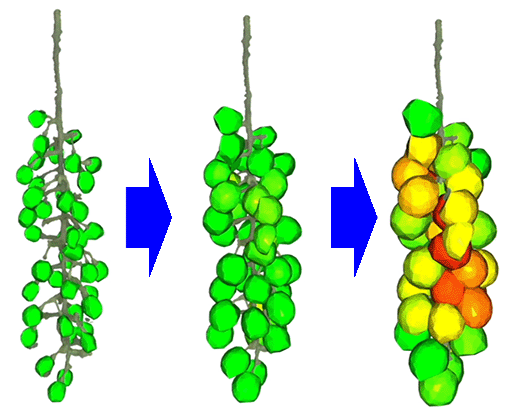
The AI then runs a cluster growth simulation using this 3D model. It predicts the cluster's ideal future shape and identifies berries that should be removed because they may hinder growth. A key feature of the system is that the AI makes data-driven decisions that were previously made by experienced growers based on their knowledge and expertise.
Once the berries to be thinned have been identified, their positional data is sent to the CRX-5iA. The robot controls its end effector position by referencing real-time tracking data from the AI camera, allowing it to accurately approach each target berry. The berry-thinning gripper then grasps and removes the berry, enabling the system to perform thinning while maintaining the overall quality of the cluster.
In this way, the system perceives the physical environment, creates a 3D model of the grape cluster in a virtual space, and uses the CRX-5iA to execute the actions determined by AI analysis and decision-making in the physical world. The defining feature of physical AI in this research is the real-time integration of physical-environment perception, analysis and decision-making in virtual space, and task execution in the real world.
Why the FANUC CRX-5iA Was Selected
Performance Requirements for Agricultural Robots
Berry-thinning robots must meet requirements that are specific to agriculture and differ from those in factories. In outdoor fields, robots are exposed to direct sunlight and dust, while operation inside greenhouses requires resistance to high temperatures and humidity. Because the berries targeted for thinning are very small, high positioning accuracy is essential. Safety is also critical because people and robots work in the same area during actual farming operations.
To meet these requirements, the University of Yamanashi research team selected FANUC's CRX-5iA collaborative robot.
Key Reasons for Selection
-
• IP67-Rated Dust and Water Resistance
Enables stable operation in harsh agricultural environments, including fields under intense sunlight and hot, humid greenhouses. -
• High Repeatability of ±0.1 mm or Better
Provides the accuracy required for the gripper to approach target berries precisely. -
• Collaborative Robot Safety
Can operate alongside people without safety fences, making it well suited to collaboration with growers. -
• Six Degrees of Freedom and a Reach of Approximately 1m
With its high flexibility and reach, the robot can approach trellis-grown grape clusters from various angles, allowing for adaptable operations in complex vineyard environments. -
• An Open Platform for Physical AI
The CRX-5iA was highly regarded for combining the environmental resistance, accuracy, safety, operational capability, and open-platform architecture required of an agricultural robot.
High Performance Demonstrated in Field Trials
Since last year, the research team has conducted ongoing field trials in outdoor vineyards and greenhouses. The CRX-5iA continued to operate reliably during outdoor berry-thinning work in June, under the high temperatures of the harvest season, and inside hot, humid greenhouses. No major problems or failures occurred during the trials, prompting the research team to comment, “We are truly pleased that we chose the CRX-5iA.”
Combining safety and durability in real-world environments is an important requirement for agricultural robots. Contact with branches and vines is sometimes unavoidable in farming environments, but the CRX-5iA's contact-stop function enabled safe operation while protecting both the robot and the surrounding crops.
In separate harvesting trials, the system has already achieved a success rate of approximately 90%, demonstrating that the high accuracy and reliability of FANUC collaborative robots can also be effectively applied to agriculture.
An Open Platform That Enables Physical AI
FANUC provides three key pillars as an open platform for enabling physical AI: ROS 2 support, Python support, and Stream Motion. The University of Yamanashi's automated berry-thinning system is an example of physical AI implementation that uses this open platform to integrate the CRX-5iA, depth sensors, AI-based image recognition, path planning, and a berry-thinning gripper.
A Development Platform Connecting AI, Sensors, and Robots
The University of Yamanashi's automated berry-thinning system does not rely on the CRX-5iA alone. It combines and controls multiple technologies, including depth sensors, AI-based image recognition, path planning, and a berry-thinning gripper. A development platform capable of flexibly connecting these elements is essential to create a seamless workflow spanning grape-cluster recognition, 3D-model generation, selection of berries for thinning, and task execution by the robot.
This is where FANUC open platform comes into play. FANUC's ROS 2 driver connects the CRX-5iA with the AI-driven control pipeline developed by the research team. Sensor data and AI recognition results can therefore be reflected in robot control in real time, allowing the physical AI system to operate in a real-world environment.
High-Precision Berry Thinning Through Real-Time Control
The position of a target berry does not remain constant during thinning. In outdoor vineyards, clusters sway in the wind, and the vibration generated when a berry is removed can also shift the target position. Simply moving the robot to a set of predetermined coordinates is therefore not sufficient for accurate thinning.
In the research team's system, AI tracks berry positions in real time and feeds this information back to the CRX-5iA's control system. By using the ROS 2 driver, the AI-based recognition system and the robot communicate at ultra-high speed, achieving low-latency, real-time control.
This allows the CRX-5iA to follow swaying clusters and changing target positions while approaching the berries to be thinned with precision. Low-latency, real-time control integration plays an essential role in realizing physical AI in which sensors “see,” AI “thinks,” and the robot “acts.”
Open Extensibility That Accelerates Research and Development
In real-world environments where people work, operating conditions and the state of target objects are not constant, and the required motions and peripheral equipment vary by application. Future robots will therefore need not only the performance of dedicated machines, but also open extensibility that allows flexible connection to external technologies such as sensors, AI, actuators, and end effectors.
In this research, the CRX-5iA is combined with an environmental depth sensor, a close-range depth sensor, a berry-thinning gripper, and AI-based image recognition. AI software developed in Python is connected to the CRX-5iA through FANUC open platform, creating a foundation that integrates the sensors, gripper, AI, and robot as a single system for testing in real-world environments.
In particular, the ROS 2 driver's connectivity with external software and its real-time control capabilities play an important role in enabling the sensors, AI, and robot to operate as one integrated system. The ability to use the robot not merely as a standalone machine, but as a development platform connected to external technologies such as AI, sensors, and actuators, is accelerating research and development for smart agriculture.
Toward the Future of Smart Agriculture
The University of Yamanashi research team aims to deploy the technology in real-world applications within four years and has progressed from implementing basic functions to improving accuracy and speed for practical application.
Outdoors, grape clusters sway in the wind, and the positions of berries recognized by the AI continue to change even while the CRX-5iA is approaching them. Further improvements in the processing speed of tracking and path planning are therefore required. To achieve the goal of reducing working hours by 40%, the team plans to improve the tracking model, optimize tracking frequency, and optimize path planning through reinforcement learning—unlocking even more of the CRX-5iA's high-speed performance.
The team also plans to further digitize the entire vineyard by using data from weather sensors, soil sensors, and other sources. By combining weather, soil, and cluster-growth data, the researchers intend to improve the accuracy of cluster-growth simulations and ultimately automate the entire vineyard using digital-twin technology.
As labor shortages and workforce aging continue, the objective is not to have robots complete every task on their own, but to create systems in which people and robots work together and support agricultural operations. This joint initiative by the University of Yamanashi and FANUC is an advanced example of how physical AI can support skilled work and expand the possibilities of smart agriculture.
Related Links
• Mao & Zhu & Buayai Laboratory, University of Yamanashi• the Bio-oriented technology Research Advancement InstitutioN (BRAIN)
* ROS is a trademark of the Open Source Robotics Foundation.
** Python is a registered trademark of the Python Software Foundation.
*** GitHub is a registered trademark of GitHub, Inc.
**** Visual Studio Code and VSCode are registered trademark of Microsoft Corporation.