

Toward the Realization of Physical AI: Where Robots Think and Act Autonomously
Physical AI is a technology that enables artificial intelligence to operate autonomously not only in virtual spaces but also in the physical world.
FANUC supports open platforms across three key pillars, accelerating the realization of Physical AI using FANUC robots for developers and researchers worldwide.
- CONCEPT
More AI, More Automation For the World
Three Pillars to Enable an Open Platform
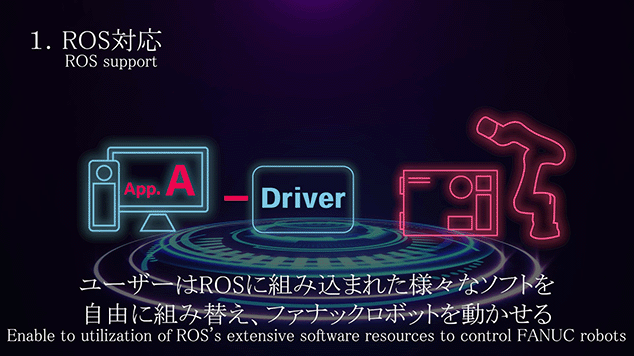
1. ROS 2* Support
FANUC develops the official ROS 2 driver, which serves as the core for robot operation, and publishes it on GitHub***. This enables users worldwide to freely reconfigure software and control FANUC robots from a PC through the open-source ROS 2 platform. In particular, FANUC’s ROS 2 driver supports industry-leading ultra-fast communication at 1 ms, enabling real-time control.
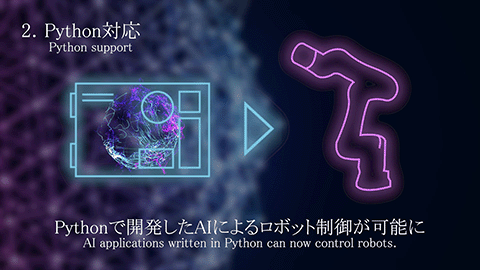
2. Python** Support
FANUC’s robot controllers can now execute Python programs directly, without the need for a PC. This enables robot control using AI developed with Python, a language widely used in AI development.
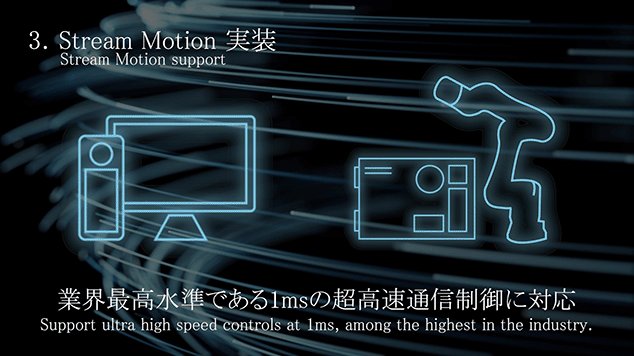
3. Stream Motion Implementation
FANUC has developed and implemented the "Stream Motion" function, a high-speed communication feature for position data commands, into its robots. This function enables real-time control of position, speed, and torque. By executing motion commands sent from a PC through ultra-high-speed communication cycle at an industry-leading level of 1 ms, it enables real-time robot control using trajectory generation software.
FANUC's Initiatives in Physical AI
To accelerate the implementation of physical AI, FANUC has forged strong partnerships with leading global technology companies and is driving industrial automation worldwide. Aiming for a future where AI solves real-world challenges through physical actions, FANUC is leading innovation across the entire industrial landscape.

Initiatives with NVIDIA
Developing physical AI depends on advanced simulations that accurately replicate real-world physics, combined with immense computing power.
FANUC integrates NVIDIA’s latest technologies with its highly reliable robots and precise motion control to deliver cutting-edge solutions that automate previously difficult tasks.
Initiatives with Google
As AI technologies like LLMs and VLMs advance, robots are gaining the ability to see, think, and act on their own.
FANUC with its proprietary control technology combined with Google’s leading AI platforms which support advanced intelligence, create next generation automation systems that can flexibly adapt to real-world conditions.

Case Studies
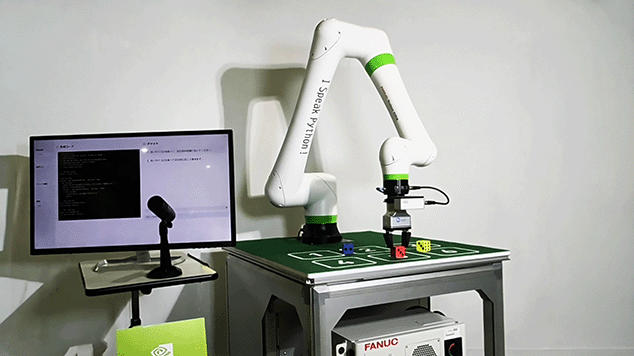
Generative AI × Robots – Voice your Command
AI robots recognize voice commands in multiple languages, automatically generate Python programs using generative AI, and execute commands while perceiving their surroundings.
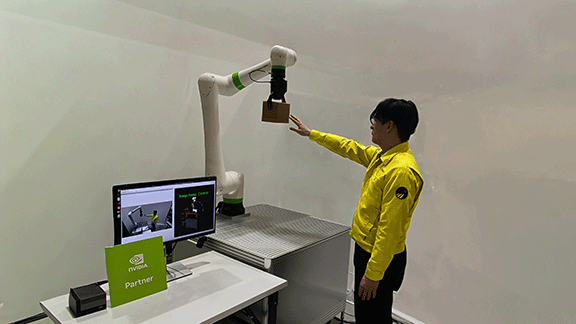
AI Robots that Avoid People
AI robots recognize people and retreat in real time without interrupting their tasks. Once the people are gone, the robot returns to its original path.
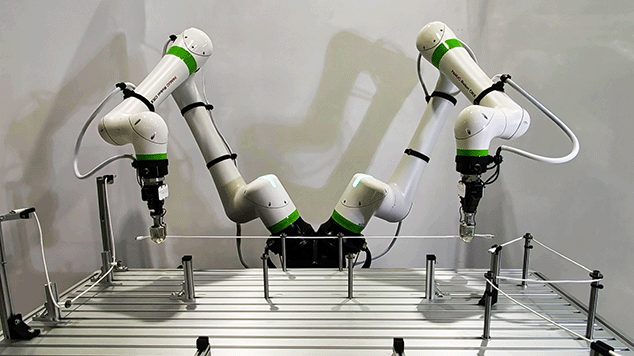
Two Arms Install a Flexible Cable
Two robot arms work collaboratively to handle soft cables with human-like dexterity, recognizing tension while performing wiring tasks.
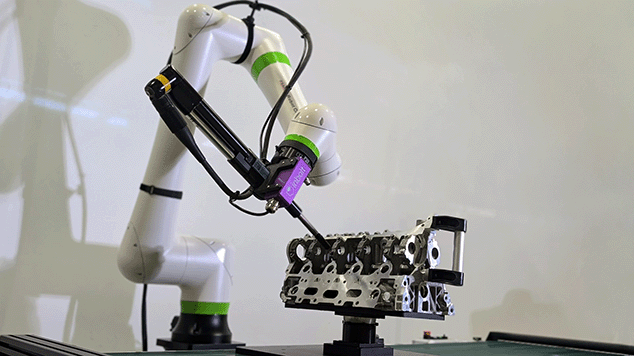
AI Robot Tracks Moving Parts, and Tightening Screws
AI robots identify workpieces moving in three dimensions and follow them in real time. They deliver high tracking performance in 3D space, enabling screw tightening while the parts are in motion.
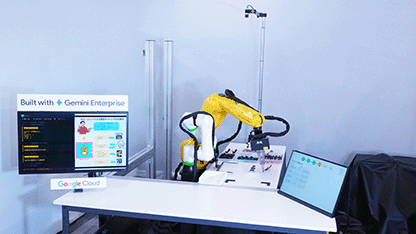
AI Agent-driven Kitting Operations
By issuing instructions in natural language to the AI agent for tasks such as photographing order forms, recognizing text, and transporting trays and parts, the robot executes the kitting of workpieces.
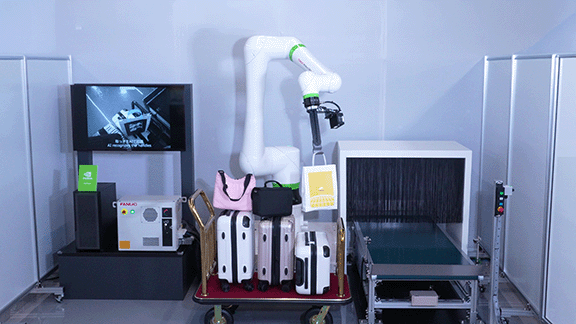
Locating “Handles” and Retrieving Baggage
Using a masterless approach, AI recognizes the "handles" of suitcases and paper bags loaded on a cart, enabling the robot to retrieve the baggage.
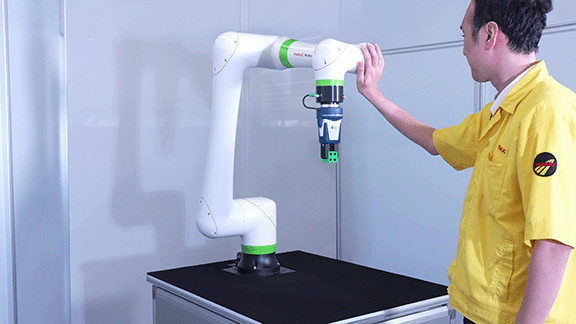
Briefly Pausing the Robot to Allow Human Intervention
If an operating robot is touched by a person, it pauses, allowing the person to safely intervene and perform tasks. Once released, the robot resumes its operation.
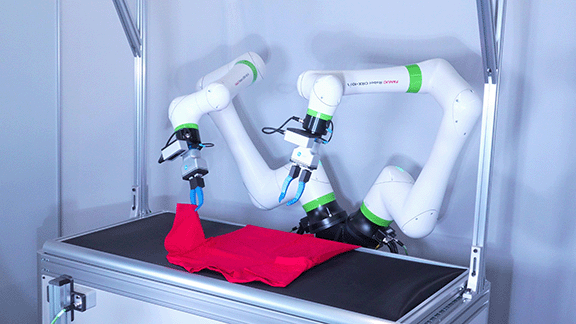
AI Robots Imitating Human Tasks
Two robot arms utilize imitation learning to acquire human skills and successfully fold a T-shirt—a highly flexible object.
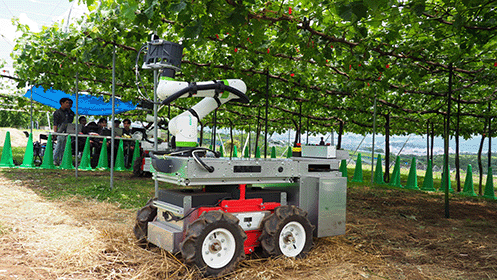
Automating Grape Berry Thinning
We spoke with the team about their research, which is opening up the future of smart agriculture through repeated field trials under demanding agricultural conditions.
* ROS is a trademark of the Open Source Robotics Foundation.
** Python is a registered trademark of the Python Software Foundation.
*** GitHub is a registered trademark of GitHub, Inc.