FANUC Open Platform

Further Realizing Physical AI
The importance of the latest AI technologies, including Large Language and Vision Models (LLMs/VLMs), has been rapidly increasing, enabling robots to autonomously see, think, and act. FANUC combines Google's state-of-the-art AI and development platforms, which support advanced intelligence, with its proprietary control technology to deploy next-generation automation systems capable of flexibly adapting to environmental changes.
Launching Our Collaboration with Google
To expand the possibilities of physical AI and minimize the barriers to robot utilization, FANUC is driving the following initiatives:
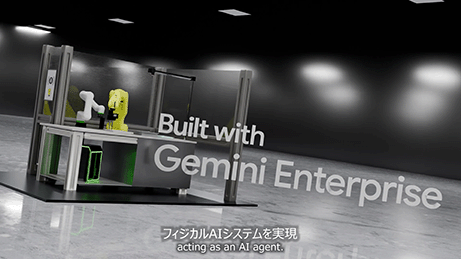
Implementation of Systems Utilizing Generative AI
FANUC has built a novel physical AI system that utilizes Google's generative AI, "Gemini Enterprise," as an AI agent. This agent accurately interprets the intent behind ambiguous human instructions provided via voice or text, links this information with camera image data, and autonomously assesses the situation on the shop floor. By doing so, it liberates users from conventional, complex teaching tasks and provides a breakthrough interface that allows anyone to operate robots intuitively using natural language.
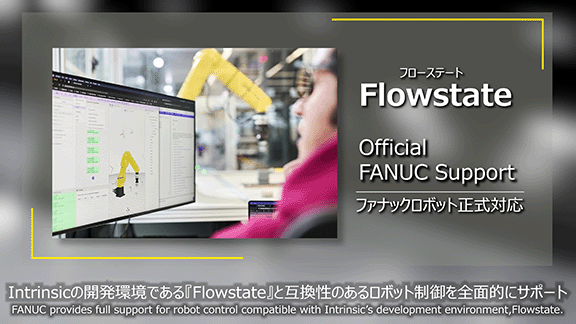
Compatibility with the "Flowstate" Robot Development Software
FANUC robots now support the robot system development software developed by "Intrinsic," Google's AI robotics software company. This enables users to rapidly build advanced robot applications through an intuitive, web-based interface without requiring specialized programming knowledge. It realizes a next-generation development environment that drastically lowers the barrier for automation adoption by significantly reducing the time and cost required for peripheral device connectivity and system integration.
Participation in Cutting-Edge AI Research Programs
FANUC is participating in Google DeepMind's "Gemini Robotics Trusted Tester" program, embarking on joint research for next-generation AI for robot systems. This initiative combines FANUC's long-cultivated industrial robotics expertise and physical data with the latest robotics foundation models developed by the world's premier AI research institution. By fusing state-of-the-art software and hardware, we will powerfully accelerate the practical application of autonomous robots.
Innovation that Redefines Robot System Development
The collaboration between FANUC and Google will fundamentally redefine conventional approaches in robot system development. The greatest innovation lies in enabling anyone to operate robots intuitively, eliminating the need for specialized coding or meticulous teaching.

1. "AI Agents" That Understand Human Language
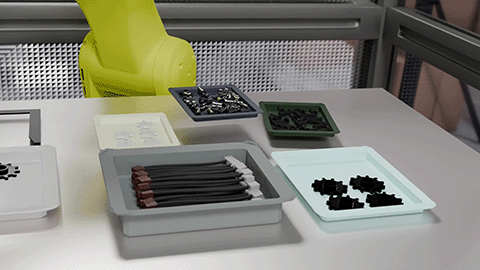
At the core of the system is an "AI Agent" with advanced conversational and recognition capabilities. The AI agent accurately understands natural human language (instructions) and independently recognizes the objects and its surrounding environment.
2. Autonomous Multi-Robot Operation
There is no longer a need to program the precise shapes of parts or their exact placement locations. Guided by the instructions of the AI agent, multiple robots operate in coordination. This enables a functioning physical AI system that adapts flexibly to ever-changing environments in a human-like manner.
3. Next-Generation Automation Working as a Team
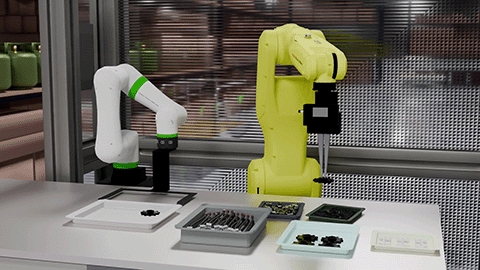
Collaborative and industrial robots equipped with "AI Agents" do not merely operate independently, but also work together intelligently as a unified team to accomplish tasks.
Working Toward a World Where Anyone Can Intuitively Operate Robots
This next-generation automation overcomes complex challenges previously considered impossible to automate, allowing anyone to operate robots intuitively. The rock-solid reliability of FANUC, paired with Google's world-leading intelligence is a powerful collaboration will pave the way for the future of autonomous robots, further expanding the possibilities of manufacturing.
* ROS is a trademark of the Open Source Robotics Foundation.
** Python is a registered trademark of the Python Software Foundation.
*** GitHub is a registered trademark of GitHub, Inc.
**** Visual Studio Code and VSCode are trademarks of Microsoft Corporation.