FANUC Open Platform

Advancing Physical AI
In the development of physical AI, advanced simulation technologies that accurately replicate real-world physics, along with overwhelming computational power, have become indispensable. FANUC integrates NVIDIA's latest technologies with its highly reliable robots and precise motion control capabilities to deploy cutting-edge solutions that enable automation of previously difficult tasks.
Further Strengthening Collaboration with NVIDIA
As the next step in utilizing physical AI at the industrial level, FANUC has achieved the following milestones:
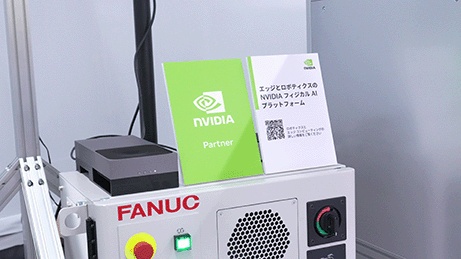
Implementation of Next-Generation AI Hardware
FANUC has developed a new system adopting NVIDIA's latest hardware, NVIDIA Jetson Thor™. By directly embedding an AI platform with overwhelming computational power, the system executes advanced AI inference processing in real-time. Seamlessly connected with FANUC robot controllers through ultra-high-speed communication, it realizes smooth, latency-free motion, even for tasks requiring complex judgments.
Proof of Concept for "Imitation Learning"
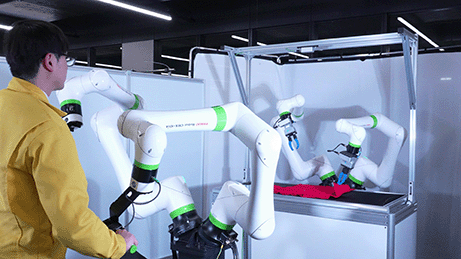
Leveraging NVIDIA Isaac GR00T™, a foundation model for robot learning, alongside FANUC's motion control technologies, FANUC has begun testing imitation learning. By having the AI directly learn the movements and visual data of skilled human workers, robots acquire the ability to perform complex and delicate tasks that have been difficult to describe using conventional programming. The robots autonomously adapt to environmental changes, breaking through the limitations of advanced automation previously considered impossible.
Real-Time Simulation Connectivity
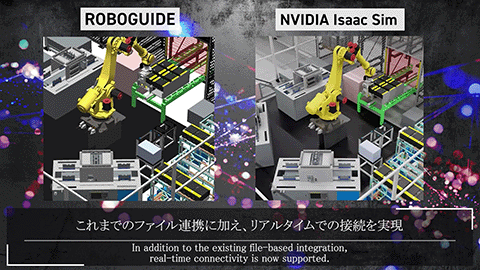
FANUC has established a real-time connection between its robot simulator ROBOGUIDE and NVIDIA Isaac Sim™. This fully synchronizes FANUC's precise robot models with a high-fidelity virtual environment that faithfully replicates real-world physics. Consequently, it enables advanced pre-verification under highly realistic conditions, significantly streamlining the Sim-to-Real (simulation to reality) deployment process.
How Physical AI "Makes the Impossible Possible"
With the realization of these technologies, the application range of industrial robots will expand significantly. The automation of highly complex tasks—such as processes that previously required intricate conditional branching and made programming itself unfeasible—is finally becoming possible.
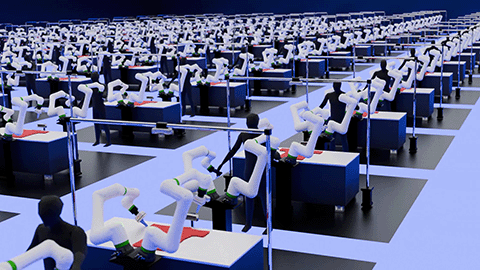
1. Infinite Learning in Virtual Space
Countless simulations are conducted in a high-fidelity virtual space where ROBOGUIDE and Isaac Sim operate in tandem. By utilizing NVIDIA Isaac GR00T to train the robot motion and object behavior, the robots autonomously acquire the ability to handle previously "unseen situations."
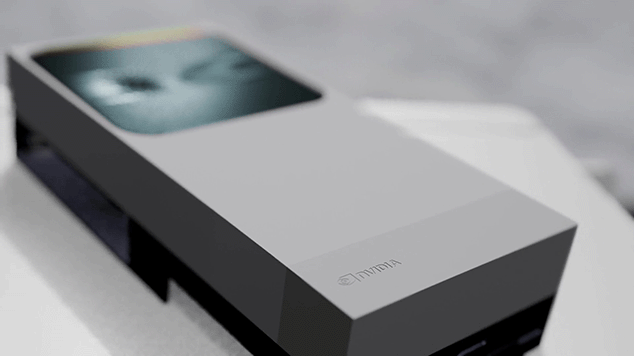
2. Real-World Deployment with Cutting-Edge Hardware
The powerful AI, forged through rigorous training in the virtual space, is then implemented into real-world robot systems using NVIDIA's latest Jetson Thor hardware.
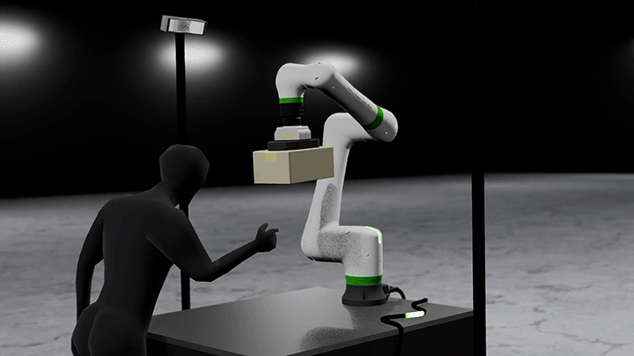
3. 3. Smooth Motion Enabled by FANUC's Precise Control
The instantaneous commands issued by the AI are transmitted via 1ms ultra-high-speed communication. Leveraging FANUC’s precise motion control technologies developed over many years, a physical AI system is completed that delivers smooth, reliable, and practically latency-free motion.
Bringing Reliable Adaptability to Ever-Changing Shop Floors
Manufacturing shop floors are constantly evolving and require judgement- based decisions to adapt to changes. By merging the "intelligence" and adaptability of cutting-edge AI with the "physical body" of FANUC robots, which boast an overwhelming track record and reliability, physical AI robot systems will thrive. The powerful collaboration between FANUC and NVIDIA will drive physical AI into its next stage of evolution.
* ROS is a trademark of the Open Source Robotics Foundation.
** Python is a registered trademark of the Python Software Foundation.
*** GitHub is a registered trademark of GitHub, Inc.
**** Visual Studio Code and VSCode are trademarks of Microsoft Corporation.